What Is Sound Healing?
One question I’m asked more than anything is: What is sound healing?
And while it’s not the easiest concept to pin down in a single definition, I want to offer a simple explanation—something that helps newcomers get their bearings and maybe gives even seasoned practitioners a new perspective.
At its simplest, sound healing is an ancient healing modality that uses vibration and frequency to help us return to a more balanced state—physically, mentally, and emotionally. Long before modern wellness trends existed, humans lived inside a constant symphony of natural sound. Birds at dawn, rivers moving over stone, wind weaving through the trees. Whether we’re conscious of it or not, we’re shaped by the world’s frequencies.
Today, we’re still surrounded by sound, but often of a very different nature: alarms shaking us awake, traffic during the commute, workplace chatter, phones buzzing with notifications. Sound plays an integral role in daily life, and when we slow down long enough to actually listen, we realize just how deeply all of this noise influences how we feel.
This is where modern sound healing enters the picture.
Sound is frequency. Frequency is vibration. And the strongest medium for vibration is water. Because the human body is roughly 60 percent water, we’re physiologically wired to be moved by sound on a level that goes far beyond hearing. We don’t just hear sound—we absorb it.
This is why the sounds we surround ourselves with matter. If we’re constantly taking in harsh noise, chaotic music, or environments full of tension, it’s not surprising that we end up feeling drained, stressed, anxious, or generally “out of tune.” The body responds to dissonance just as it responds to harmony.
Think of an instrument that’s been sitting untouched for a long time. Before you can play it well, you have to tune it. Our minds and bodies aren’t much different. Stress, emotional heaviness, unhealthy environments, and even unprocessed memories can pull us out of alignment. Sound healing acts as a kind of tuner—realigning us with ourselves, with others, and with the world around us.
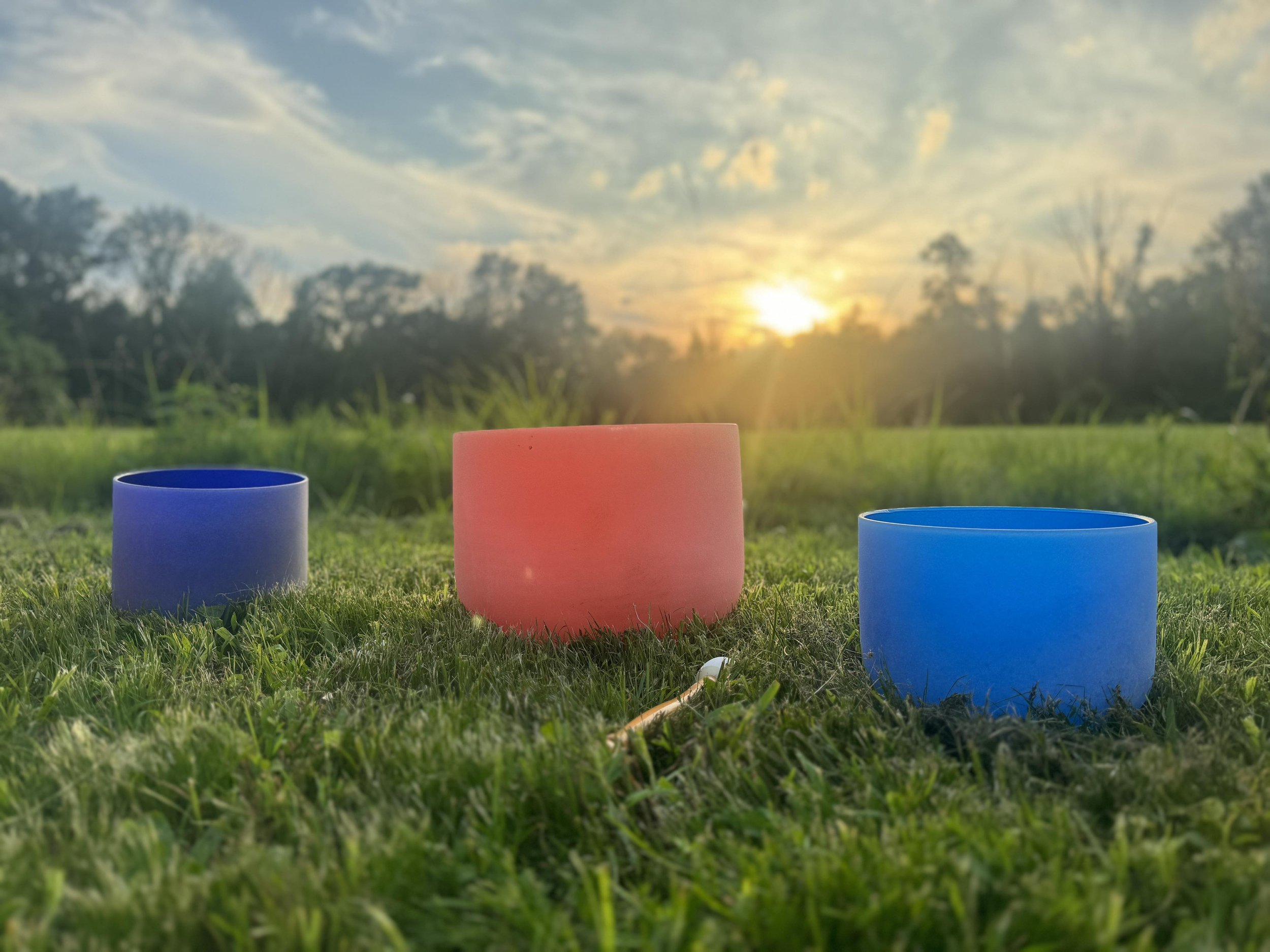
This is where holistic sound-healing instruments come in: Tibetan bowls, crystal bowls, gongs, tuning forks, drums, flutes, chimes, handpan, and even the human voice. These tools weren’t all originally designed with “sound healing” in mind, yet over generations they’ve proven to be remarkably effective for vibrational work. Many produce pure, stable frequencies that the body can easily lock into.
But sound healing isn’t only about instruments. It is also about intention, presence, and the space in which sound is delivered. A sound bath, for example, isn’t merely listening—it’s receiving. The vibrations wash through the body and change the internal landscape in subtle, meaningful ways. For some people, it brings physical relaxation. For others, it unlocks emotional release or invites deep clarity. The experience is different for everyone, and that’s part of its beauty.
If you’re in a negative or unsettled state of mind, listening to pure, resonant frequencies can be grounding. Sometimes the shift is soft and gradual. Other times it’s immediate and almost surprising, like a moment of quiet you didn’t know you needed.

Dutch physicist Christian Huygens - notable for his work in entrainment
One of the core scientific principles behind sound healing is entrainment—the idea that two frequencies vibrating at different rates will gradually synchronize when they share the same space for long enough. Dutch physicist Christian Huygens first noticed this in the 17th century when two unsynchronized pendulum clocks hanging on the same beam began swinging in perfect unison overnight. They naturally aligned through vibration alone.
In sound healing, the body responds the same way. When we surround ourselves with coherent, stable frequencies, our internal rhythms—breath, heart rate, brainwaves, emotional responses—gradually entrain to that stability. Over time, this can create a deep sense of calm, clarity, connection, and overall alignment.
Another important aspect of sound healing involves brainwave states. Different frequencies can gently guide us into states associated with relaxation, creativity, meditation, and restorative rest. This is why many people use sound healing to support sleep, reduce anxiety, assist meditation, or help regulate the nervous system. The shift isn’t forced; it’s a natural settling as the mind responds to vibration.
Sound healing also creates space for introspection. When external noise softens and the body drops into stillness, the mind often becomes clearer. Many people describe feeling more connected to themselves, more grounded in their emotions, or more aware of what they’ve been carrying. Sometimes the experience is simply peaceful; sometimes it’s transformative.
So, in essence, sound healing is vibrational therapy. It’s a way of tuning ourselves—returning to our natural rhythm, reconnecting with the universe, and reestablishing balance where life has knocked us off center.
If you’ve never tried incorporating these frequencies into your day-to-day life, I encourage you to explore them. Listen to a recording of crystal bowls, sit with the resonance of a gong, hum or chant, try a tuning fork, or attend a sound bath. Notice what shifts. You might be surprised by how much the body responds when given a chance to settle back into harmony.
